What are QUICK TAKES?
Like many of you, we like to read. These are some of our favorite books. We jotted down some highlights, and we asked our AI team member to organize our thoughts. The name "book summary" is a stretch, so we named this work QUICK TAKES. Definitely some good reads on the list. There is a wide variety of general business books, LEAN books including some classics, as well as books on the power of story telling. Enjoy!
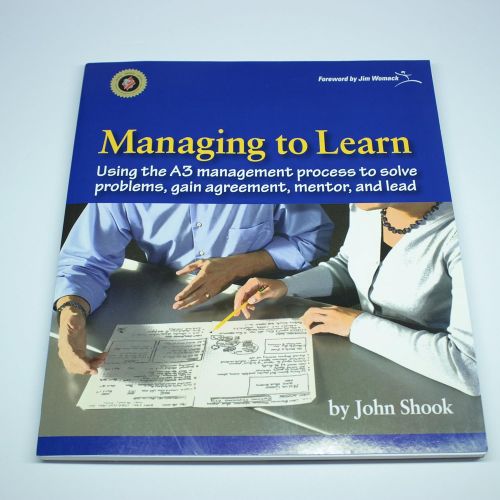
Managing to Learn by John Shook
Introduction
In "Managing to Learn," John Shook takes what could have been a dry manual on a Toyota planning tool and turns it into something far more human: a story about how people learn, and how leaders learn to lead. Drawing on his years as the first American manager at Toyota, Shook builds the book around a deceptively simple artifact—the A3, a single sheet of paper on which a problem is defined, analyzed, and solved. His thesis is that the A3 is not really about the paper at all. It is a way of thinking, a management process, and above all a method for developing the problem-solving capability of the people who do the work. Master the A3, Shook argues, and you master the discipline at the heart of Toyota's approach to continuous improvement.
A Story, Not a Manual
Rather than lecture, Shook teaches through narrative. We follow Desi Porter, a capable but impatient middle manager, as he is handed a thorny assignment: fix the document translation process whose failures have contributed to a late plant start-up. Watching over him is Ken Sanderson, the site manager, who has decided that his job is not to solve Porter's problem for him but to develop Porter into someone who can. The book unfolds in layered voices—Porter's journey through the work, Sanderson's private struggle as a mentor, and a series of information blocks and evolving A3 drafts that show the thinking maturing in real time. This structure lets readers experience both sides of the learning relationship at once, which is precisely the point.
What Is an A3?
Named for the international paper size (roughly 11" x 17"), the A3 is a standardized format for capturing an entire problem-solving effort on one page. The constraint is intentional. Forcing a complex issue onto a single sheet demands clarity, prioritization, and honesty about what is actually known. Shook describes the A3 as simultaneously a piece of paper, a methodology, and a process—a tool that carries a way of thinking inside it. When done well, an A3 tells a coherent story that any reader can follow from problem to proposal, and it does so with facts observed firsthand rather than assumptions gathered secondhand.
The Anatomy of an A3
At the core of the method is a logical flow that moves from understanding a problem to acting on it. While the exact layout varies, Shook's A3 typically progresses through a consistent set of elements:
- Background and Title: The A3 opens by naming the problem and framing why it matters to the business. A good title and background establish the theme and connect the work to a larger organizational purpose.
- Current Conditions: The author documents what is actually happening today, based on going to see the work directly (the gemba). This section relies on facts, data, and simple visuals rather than opinion.
- Goals and Targets: Here the author defines the desired outcome in concrete, measurable terms, making clear what success will look like.
- Root Cause Analysis: Rather than jumping to solutions, the author digs beneath the symptoms—repeatedly asking "why"—to identify the true causes of the gap between current and target conditions.
- Countermeasures: The author proposes specific actions aimed at the root causes. Shook favors the word "countermeasure" over "solution," a reminder that improvements are provisional and subject to further learning.
- Plan and Follow-up: The A3 closes with an implementation plan—who does what, by when—and a follow-up section that specifies how results will be checked and what was learned.
PDCA: The Thinking Behind the Paper
The A3 is a physical expression of the Plan-Do-Check-Act cycle, the disciplined rhythm of continuous improvement. Planning covers the problem definition, analysis, and proposed countermeasures; doing means executing the plan; checking compares actual results against the targets; and acting means standardizing what worked and adjusting what did not. Shook stresses that the check and act stages are where most organizations fall short. Filling out the boxes is easy; returning to confirm whether the countermeasures actually closed the gap—and honestly learning from the answer—is the harder, more valuable habit the A3 is designed to instill.
From Problem-Solving to People Development
The book's deepest insight is that the A3 is as much a leadership tool as a problem-solving one. Sanderson's real work is not the translation problem; it is Porter. Again and again, Sanderson resists the urge to supply answers, choosing instead to ask questions that push Porter to go and see for himself, to test his own logic, and to own his conclusions. This is what Shook means by "managing to learn": the manager's purpose is to build capability in others, and the A3 becomes the medium through which mentoring happens. The person who writes the A3 must be its true author, because ownership is what makes the learning stick.
Gaining Agreement: Nemawashi and Catchball
An A3 is never written in isolation. Shook shows how effective problem-solvers use the process to align the organization before decisions are finalized. Through nemawashi—the patient, informal work of building consensus by consulting affected parties in advance—and catchball, the back-and-forth dialogue in which ideas are tossed between mentor and mentee and across departments, the A3 becomes a vehicle for agreement rather than a memo imposing a decision. By the time a proposal is presented formally, the groundwork of buy-in has already been laid. The single sheet of paper thus does quiet, powerful political and relational work in addition to its analytical work.
Responsibility Without Authority
One of the book's most quietly radical ideas is that A3 authors are expected to lead across the organization without necessarily holding formal authority over the people they need. Porter cannot command the various functions involved in translation; he must earn their cooperation through the clarity of his thinking and the credibility of his facts. Shook presents this "responsibility without authority" as a feature, not a bug: it develops leaders who influence through logic, dialogue, and shared purpose rather than positional power—precisely the kind of leadership a learning organization runs on.
Critique and Comparison
Shook's contribution sits alongside a broader lean literature, echoing the scientific-thinking spirit of works like Mike Rother's "Toyota Kata" and the systems view of "The Toyota Way." What distinguishes "Managing to Learn" is its insistence that a management tool and a human-development philosophy are inseparable. Some readers may wish for more prescriptive templates or a wider range of worked examples beyond the single translation case. But that restraint is deliberate; Shook is wary of turning the A3 into a fill-in-the-blank form, which is exactly the trap that drains the tool of its thinking. The book models the very discipline it teaches, favoring depth over breadth.
Conclusion: Learning to Lead, One A3 at a Time
In the end, "Managing to Learn" is a book about a piece of paper only in the way that a great recipe is about a sheet of instructions. The real subject is a mindset—curious, fact-based, humble about what is known, and relentless about learning from results. By following Porter and Sanderson through a single problem, Shook gives readers both the mechanics of the A3 process and, more importantly, the way of thinking and leading that animates it. For managers who want to stop firefighting and start building an organization that solves its own problems, the message is clear: your job is not to have the answers, but to develop the people who will find them. Master that, and the A3 becomes what Shook intends—the key to learning your way to better performance, one problem at a time.