

A LEAN maturity review across five principles. Know exactly where you stand.

You can feel where the plant hurts. Lead times creep, the same problems keep coming back, and every improvement push seems to start in a different corner. But if someone asked you to point to exactly where you're strong, where you're bleeding, and back it with more than a gut read, that's harder than it should be. You can't fix what you've never honestly measured.
You can feel where the plant hurts. Lead times creep, the same problems keep coming back, and every improvement push seems to start in a different corner. But if someone asked you to point to exactly where you're strong, where you're bleeding, and back it with more than a gut read, that's harder than it should be. You can't fix what you've never honestly measured.

We use two assessment models. A Rapid Plant Assessment (RPA) and a Comprehensive Plant Assessment (CPA). Both models break down the plant scoring into five (5) key areas and use the same 100 point scale. These models have been time tested at literally hundreds of plants across diverse industries.
The RPA is a streamlined approach that can be used as a self-assessment tool OR a one-day onsite assessment. It produces a generalized LEAN maturity score and Action Plan. Take our RPA for a test drive HERE.
CPA is a detailed approach that integrates personnel interviews, process walks, and SOP reviews to provide a more accurate and actionable analysis. The typical CPA duration is usually three (3) weeks. One (1) week offsite info gathering and preliminary interviews. One (1) week onsite. One (1) week offsite detailed report creation and leadership follow-up.
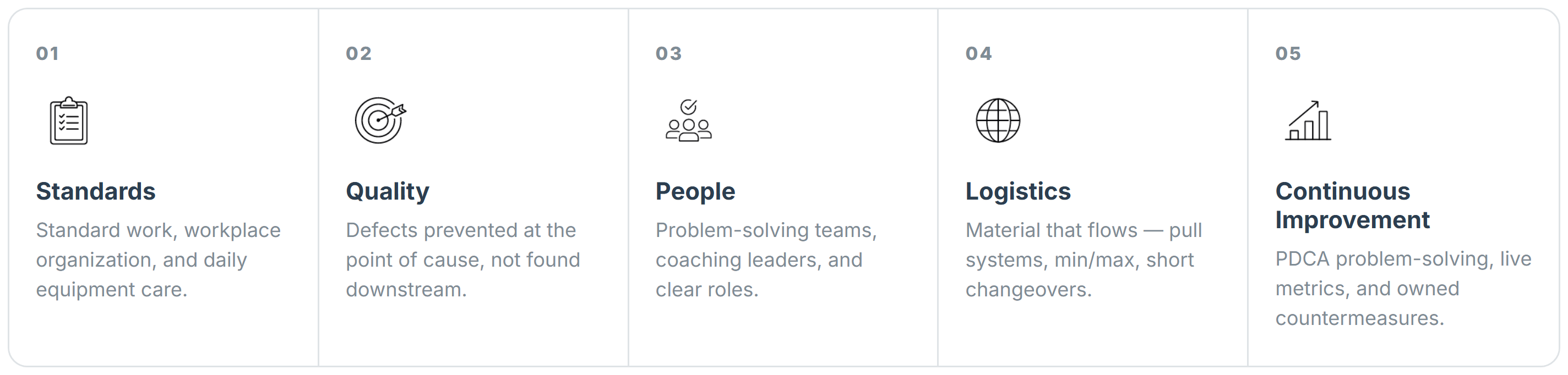
The five (5) key areas are:
Summary reporting:
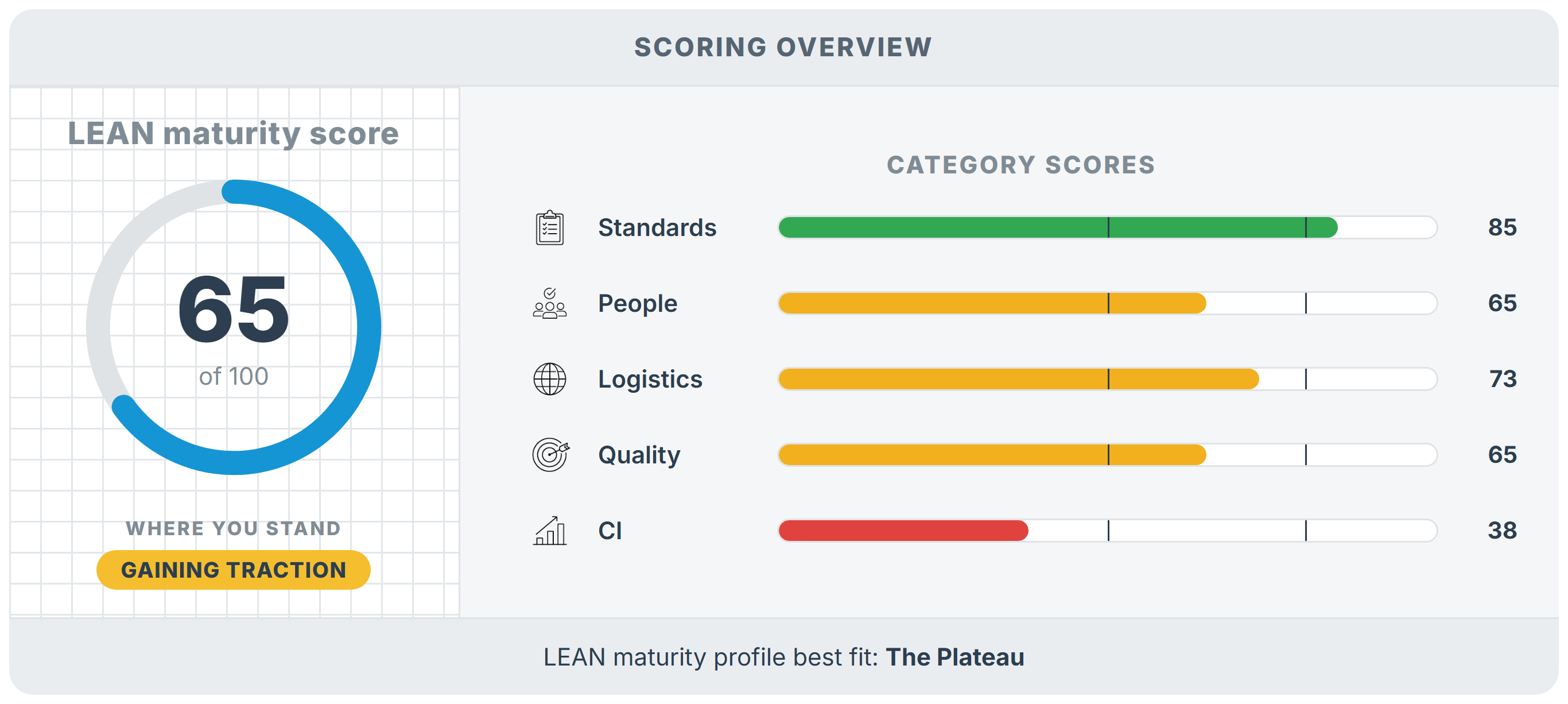

The CPA provides a detailed snapshot of plant operations and, based on leadership input, provides a robust 6 month plan to make significant improvements in the areas of opportunity identified. As stated above, the process occurs over three (3) weeks and is broken down as follows:
Week 1: Information Gathering (off-site)
- Assessment kickoff meeting
- Plant background information
- Report structure (Areas)
- Safety and Logistics
Week 2: Onsite Review
- Production interviews
- Leadership interviews
- Meeting cadence and huddle reviews
- Process walks in all Areas
- Dashboard reviews
- Business plan reviews
- SOP reviews
- End of Week Report Summary Presentation (scoring, high-level strengths and opportunities)
Week 3: Report and Next Steps
- Comprehensive report created with detailed notes
- 6 month Action Plan
- Final Presentation

You stop guessing. You know where you stand across all five principles, and which fire is actually worth fighting first.
You get a plan you can use Monday, not a binder that goes on a shelf. And you get something you can take upstairs. When the GM says do more with less, now you've got a defensible read on the plant and a direction, instead of just more pressure.

We score what's on your floor, not what the paperwork claims. Plain-language statements, real observation, your people's own input. The five principles map to how a plant genuinely runs, and no score ever lands without the why behind it and the next move to fix it.
And the assessment stands on its own. It's the front door, not a foot in it. It'll tell you honestly whether what you need next is a full transformation, a triage, or just a few focused moves you can run yourselves. The team that scores you is the same team that can help you close the gaps, and hand you the platform that keeps them closed.

Get your score first. The Rapid Plant Assessment takes five minutes and costs nothing.
Then, if you want the deep read, we'll walk your floor and show you what an onsite assessment turns up.