
Issue N035
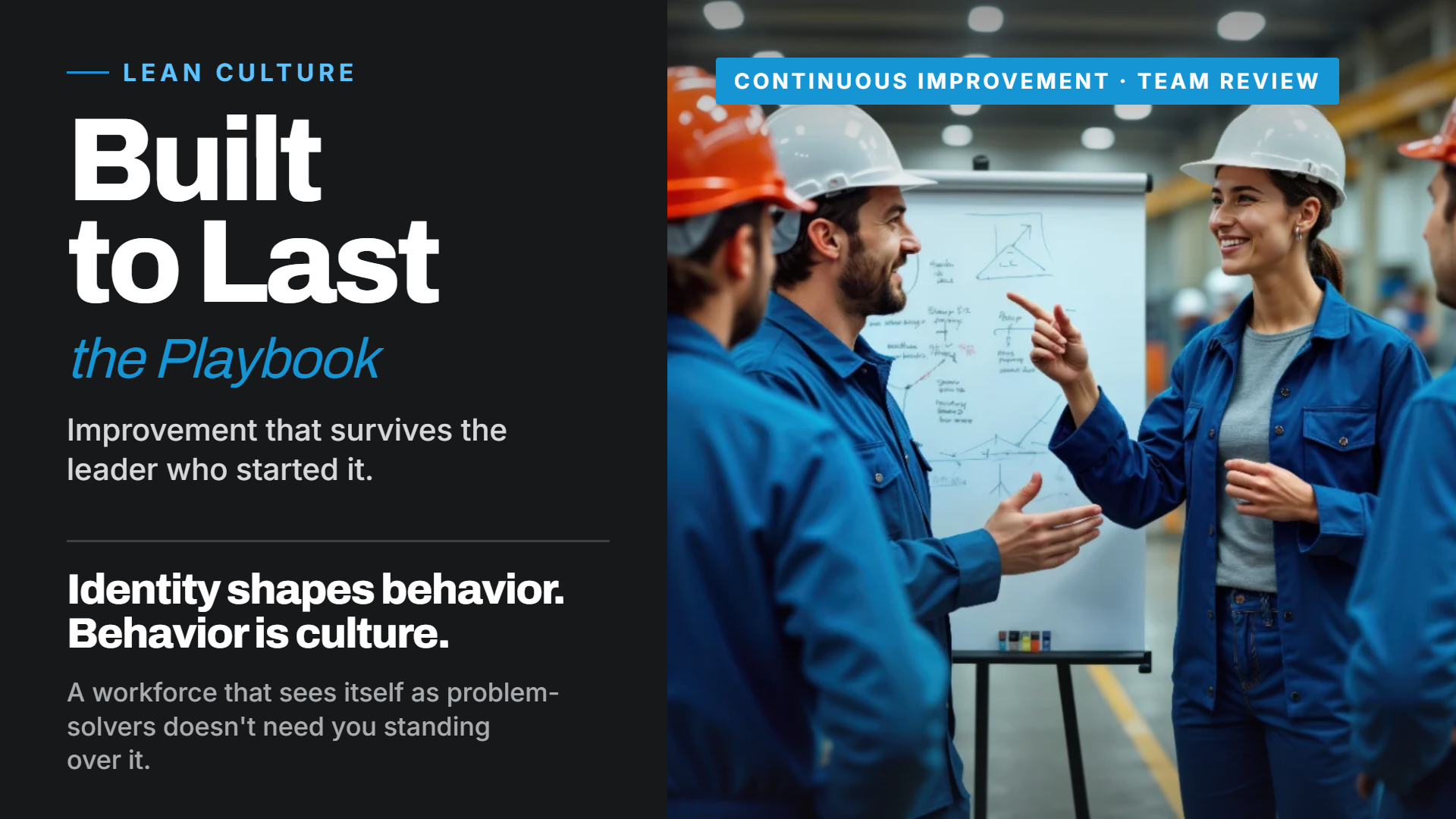
LEAN Culture - Built to Last Playbook
Walk into a plant a year after the transformation launched. You'll know in ten minutes whether anything they built survived.
The 5S boards are either living or they're wallpaper. The huddles are either where problems get solved or where people wait for the clock. The improvements you were so proud of are either the new floor everyone stands on, or a photo in an old kickoff deck.
That's the real test of a leader's legacy. Not the results you posted while you were watching. What holds after you stop watching.
Here's the uncomfortable part. Most of what we call a LEAN transformation is really a LEAN performance. New leaders are especially good at starting them. A fresh name, a kickoff, a burst of energy while the boss is watching and asking about it. Then their inspiration fades, or they move on, and the work they started becomes another transformation relic. Not because people are lazy. Because the whole process hinged on one leader.
So how do you build the kind that lasts? Here's a playbook that makes improvement part of the culture. A handful of plays, run in the right order, that any operation can follow.
The Two Imperatives
But the plays only work if you're clear on what culture actually is first.
Identity shapes behavior. And behavior, repeated across a whole workforce, is culture. That's the whole chain. So if you want a culture of continuous improvement, you can't start with slogans about improvement. You have to change what people do every day until it becomes who they are.
And people do two things reliably: what they're expected to do, and what they're encouraged to do. Those are the two imperatives, and you need both. Miss either one and it doesn't stick. Expectation without encouragement feels like a mandate nobody believes in. Encouragement without expectation is a nice program that fades the first busy week.
Everything below is built to deliver both.
Implement Small Teams
First, one piece of structure, because it's the unit everything else runs on.
Continuous improvement doesn't happen in a workforce of hundreds. It happens in small teams. Five to eight people, each with a team leader whose job is to facilitate and support them. Full time or part time depending on your scale, but a real role with real time carved out for it, not a title bolted onto someone already underwater. The team leader is the first answer in the help chain. The one who protects the improvement time and keeps the board honest. The one who brings the team's problems to the weekly review. Small teams make problems visible and ownership obvious. Get this wrong and the plays below have nothing to stand on.
Build the Operations Manual
This is where you set the expectation, in writing.
Start with the boring document. An operations manual, the HR kind, that defines the basic roles in your company and the expectations for each one. This isn't bureaucracy for its own sake. It's how you move improvement from "a thing some motivated people do" to "part of what this role is."
Every role gets its normal duties. And every role, top to bottom, carries one more line: you are expected to make improvements to your own job. The operator, the scheduler, the maintenance tech, the plant manager. Nobody is exempt from making their corner of the business a little better. When it's written down as an expectation of the role, it stops being optional and stops being heroic. It's just the job.
Then, in that same manual, define the help chain. This is the part most companies skip, and it's the part that makes the whole thing real. When someone hits a problem they can't solve alone, how do they call for help? Who is supposed to respond, starting with their team leader? How fast, under normal conditions? And if no one comes, how does that call escalate past the team leader to the next level?
Write all of that down. Because a call for help with no defined response is how you teach people to stop asking. The help chain is the promise behind the expectation. You're telling every role: we expect you to surface problems, and here's exactly who has your back when you do.
Train the Basic Skills
Now you've set the expectation. Expectation alone gets you compliance, not culture. So next you make people capable and willing.
Train them in three things. First, basic problem solving, so a normal person on the floor can take a nagging issue and actually work it instead of living with it. Not a certification marathon. Just the simple tools and the confidence to use them.
Second, how the score is kept. Improvements aren't vague. They show up in safety, quality, delivery, and cost. When people can see that a change they made moved one of those, the work gets real. It stops being "extra" and starts being obviously worth doing.
Third, how to lock the gain in with a standard. This is the step everybody skips, and it's the reason improvements evaporate. An improvement that lives in one person's head walks out the door with them. Written into the standard, it becomes the new way the job is done, the floor the next improvement stands on. No standard, no kaizen. A change you can't hold isn't an improvement, it's a good day.
And here's where a lot of leaders quietly fail. You have to build in the time and the place. Time, meaning actual protected minutes for people to work on problems, because "do it when you get a chance" means never. And a place, a visible board or space where the work gets posted. Where a half-finished improvement is out in the open, where people can see what their team is chipping away at. What gets posted gets pride. What stays invisible dies.
Run the Leadership Reviews
Expectation and motivation get the flywheel turning. Leadership attention keeps it turning. So the next play is a review process, and it belongs to the leaders.
Set the expectation that every small team shows up having identified real, impactful problems. Not busywork improvements. Things that matter. Then facilitate the reviews weekly. Weekly, because monthly is too slow to build a habit and the flywheel stalls between sessions.
Two things happen in those reviews, and the second matters more than the first. You reinforce the expectation, week after week, so nobody drifts back to firefighting-only. And you recognize completed work. Out loud, by name, in front of peers. This is the payoff the whole system is built to deliver. People will hunt for problems all day long if the reward is being seen doing good work. Recognition is the cheapest, most powerful fuel a leader has, and it's the one most leaders forget to spend.
Document the Process
And write the review itself down. The cadence, who runs it, where it happens, what gets covered. Put it in the same operations manual as everything else.
This is the piece leaders skip, and it's exactly the piece that fades when they leave. A review that lives only in the current leader's habits leaves with that leader. A review that's written down as how this company runs is a review the next leader inherits instead of forgets. That's the whole point of this playbook. You're building something that survives a change at the top, so document the thing most likely to walk out the door with it.
That's the core of it. Small teams as the unit. Expectation in writing, so improvement is part of every job and help always comes. Motivation, so people can solve problems, see the result in safety, quality, delivery, and cost, and lock it in with a standard. A weekly leadership rhythm that reinforces the expectation and celebrates the wins. And all of it documented, so none of it depends on you being in the room.
Do that long enough and something changes. The behavior becomes the habit. The habit becomes the identity. And a workforce that sees itself as problem-solvers doesn't need you standing over it.
Which brings it back to legacy. Build this and walk that same plant a year after you've gone. The boards are alive. The huddles solve things. The improvements are just the floor now.
That's the culture that outlasts you. And it's the only kind worth building.
What's the one thing you've built that you're confident would outlast you?
RELATED COURSES
RECENT